Platform
From exposure to action. Continuously.
Our Continuous Threat Exposure Management (CTEM) platform combines External Attack Surface Management (EASM) with internal asset and business context to identify what attackers can reach, determine what matters, and prioritize what to fix.
Five phases create one continuous loop: Scoping, Discovery, Prioritization, Validation and Mobilization.
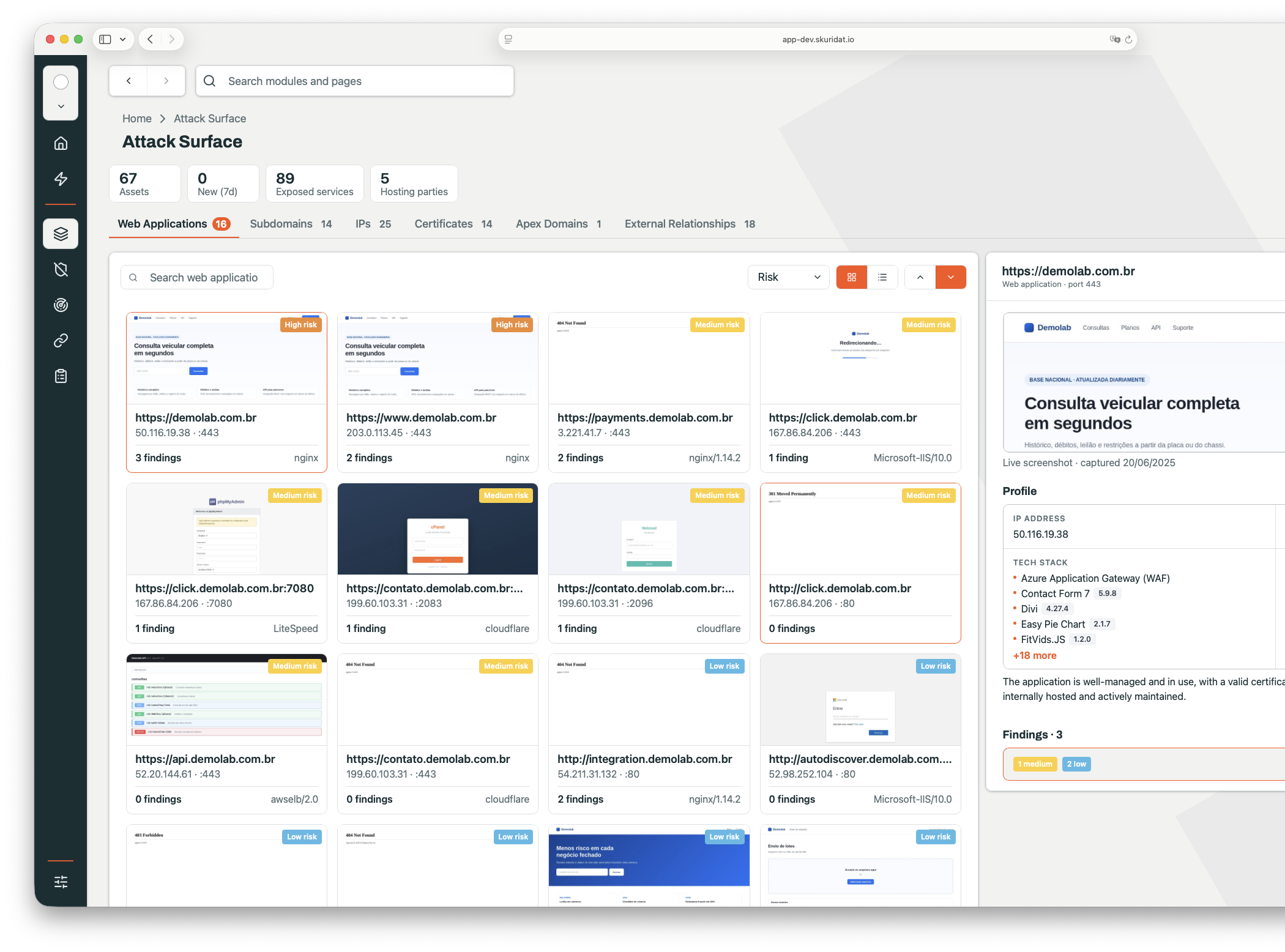
01 · Scoping
Start from the business, not the asset list.
Scope exposure management around the business services that drive revenue, operations and obligations. Then connect the assets and dependencies they rely on.
Scope your board recognizes.
02 · Discovery
Find what is exposed, including what you forgot.
Continuously discover internet-facing assets, shadow IT, forgotten infrastructure and supplier connections across your external attack surface—not just what appears in the CMDB.
No unknown front doors.
03 · Prioritization
Rank by exposure and impact.
Prioritize vulnerabilities by exploitability, reachability and business impact—turning an unbounded vulnerability backlog into the exposures that actually deserve attention.
A short list, not a queue.
04 · Validation
Prove the attack path is real.
Validate whether a prioritized exposure creates a viable attack path before committing remediation effort. Give your team evidence of how an attacker could reach what matters.
No effort spent on theory.
05 · Mobilization
Get it fixed, with the owner who can fix it.
Turn prioritized exposures into remediation tasks in the workflows your team already uses—with context, ownership, recommended actions and deadlines. Then track them through closure.
Remediation you can measure.
Built on a European stack.
Every layer runs on an EU-domiciled provider. Data residency is an architectural constraint, not a configuration option.
- EEA-only SaaS Every layer, from compute to AI inference, runs on EU-domiciled providers.
- Containerised client environments Each client runs in its own isolated container, with separate data, keys and runtime.
- Intelligence, vulnerability and dark web sources CSIRT advisories, EUVD, CVE and KEV, commercial feeds and dark web monitoring flow in. Nothing flows back out.
- Proprietary scanning Skuridat’s own engine maps each client’s attack surface from the outside in.
- Industry exchange Clients in the same sector share anonymised exposure patterns, so one finding warns the rest.
- Supplier graph Clients and their vendors share the data that links them, with consent on both sides.
Integrates with






Run it once
Run the loop on your environment.
Experience the same five CTEM phases we run continuously—Scoping, Discovery, Prioritization, Validation and Mobilization—focused on one critical business service.
In two weeks, see what is exposed, what matters most, which paths are real, and what to fix first. Then decide whether to keep the loop running.
Prefer to talk first? 20 minutes with a founder →
Two weeks · one business service · EU-hosted, deleted after 30 days
Example extract — first pass through the loop
Static example. Volumes depend on your estate.